3.2.2Which of the tools should I use?

Derivatives Using Multiple Strategies


3-52.

USING MULTIPLE STRATEGIES TO WRITE f

Let f(x)=x2+4x+2. You will write an equation for f using three different methods outlined below. Each method should produce the same result.   

  1. Use the definition of the derivative.

  2. Use the Power Rule.

  3. Use your graphing calculator to graph the equation f(x)=f(x+h)f(x)h for h=0.01. Examine the graph and write an approximate equation for f.

3-53.

Revisit the Power Rule from problem 3-6. Will the Power Rule work for f(x)=xn if n=0? When n is negative? What about for non-integer values of n? Investigate these conditions with your team and summarize your results.

3-54.

Expand the function f(x)=(2x3)(x2+2). Then, use that expansion and the Power Rule to write an equation for f(x). Finally, use your equation for f(x) to write the equation of the line tangent to the curve f(x)=(2x3)(x2+2) at x=3. Write your equation in point-slope form.

3-55.

Lazy Lulu wants to determine the derivative of f(x) at x=a. She used Hana’s method to set up the definition of the derivative:

limh0((9+h)21)80h

Lulu is lazy and does not want to do algebraic computations. Help Lulu undo the definition of the derivative so she can use the Power Rule instead.

  1. What is f(x)?

  2. What is the value of a?

  3. Avoid the algebra! Use the Power Rule to write an equation for f.   

  4. What is f(a)?

  5. Write the equation of the line tangent to f(x) at x=a

3-56.

ANOTHER DEFINTION OF THE DERIVATIVE: INTRODUCING ANA

Hana, Anah, and Hanah have a stepsister named Ana. Ana also found a method to determine the derivative at a point. Her method is a little different from the rest.

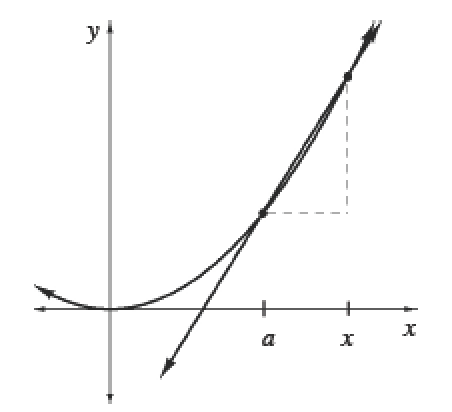
Ana’s Method:    limxaf(x)f(a)xa

  1. Use Ana’s method to confirm that the derivative of f(x)=x2 at x=2 is 4. Does Ana’s method work?

  2. Use Ana’s method to write the derivative function of f(x)=x2.  

  3. What is special about Ana’s name?

First quadrant upward increasing curve, 2 tick marks labeled, A, &, x, on the x axis, with highlighted points on the curve, corresponding to tick marks, & dashed slope triangle on the curve, between highlighted points, with increasing line, passing through the highlighted points.

3-57.

Graph the function h(x)=xsin(2x)

  1. Can you use the Power Rule to determine the derivative function? Why or why not? 

  2. Choose a coordinate on y=h(x) that is very close to (π6,h(π6)). Then use your calculator to approximate h(π6) using the slope of the secant line containing the point you chose and (π6,h(π6))

  3. Use your approximation from part (b) to write the equation of the line tangent to the curve at x=π6.

Review and Preview problems below

3-58.

Irvin recorded both his location and velocity while he rode his motorcycle; however, he forgot to label the data and thus mixed up the distance and velocity measurements. Hoping to straighten out the data, he created two graphs. Which graph below represents distance and which graph represents velocity? How do you know? Homework Help ✎

Graph A
Upward increasing curve, coming from, point on negative x axis, turning at point on positive y axis, decreasing & staying upward, to a point on positive x axis.

Graph B
Increasing curve, coming from left above x axis, changing from opening up to opening down at a point on the y axis, then continuing right with slight increase in y.

3-59.

MORE NOTABLE NOTATION FOR THE DERIVATIVE

The use of dydx comes from ΔyΔx, which is an expression for slope read as “the change in y over the change in x”. We use Δ to represent change. When the change gets smaller and smaller until it is infinitely small (infinitesimal) we use the symbol d.

It is useful to think of change when working with derivatives. For example dhdt can represent the change in the height of an object with respect to time. Create expressions using the symbol d that represent the following instantaneous change statements. Homework Help ✎

  1. The change in the velocity, v, with respect to time.

  2. The change in volume, V, with respect to the radius, r, of a cone.

  3. The change in area, A, of a circle with respect to the perimeter, p.

3-60.

Write an equation for f(x) for each function below. Homework Help ✎

  1. f(x)=9x

  1. f(x)=3x76x

  1. f(x)=5x4

  1. f(x)=m

3-61.

Sketch a graph of a function that has the properties listed below. Describe anything special about this function. 3-61 HW eToo.  Homework Help ✎

  • limxf(x)=4

  • f(1)=1

  • f(x)=f(x)

3-62.

Hanah wrote this derivative function: f(x)=limh0((x+h)23)((xh)23)2h Homework Help ✎

  1. What is the equation of f(x)?

  2. What is the equation of f(x)? (Note: Avoid the algebra by using the Power Rule.)

  3. Use your slope function to calculate f(0) and f(1).

3-63.

Answer the following questions using the graph at right, which shows the velocity of a runner over time. The letters A and B represent the areas of the two regions in the diagram. Homework Help ✎

  1. If the runner was at the starting line at t=0, describe her direction during the interval illustrated on the graph at right.

  2. What is the significance of point p?

  3. What does region A represent in this situation? That is, what does it tell you about the runner? What about region B?

  4. If A=30 meters and B=5 meters, what does A+B represent in this situation? Why is B negative?

Coordinate plane, x axis labeled, t, y axis labeled, v of t, downward curve starting at the origin, turning down at point in first quadrant, changing from opening down to opening up at point on positive x axis, labeled, p, turning up in fourth quadrant, stopping at the x axis, region below curve in first quadrant, labeled A, region above curve in fourth quadrant, labeled, B.

3-64.

Using the definition of the derivative as a limit, show that the derivative of f(x)=1x2 is f(x)=2x3. That is, show algebraically that the following limit statement is true: Homework Help ✎

limh01(x+h)21x2h=2x3

3-65.

Write the equation of a function that has vertical asymptotes at x=3 and x=5, a hole at x=0 and a horizontal asymptote at y=2. Sketch a graph of the function. Homework Help ✎

3-66.

Evaluate each limit. If the limit does not exist due to a vertical asymptote, then add an approach statement stating if y is approaching negative or positive infinity. Homework Help ✎

  1. limx1+x2+2x3x22x+1

  1. limxx2+6x+53x2+4

  1. limx9x3x9

  1. limx2x2+x+1x+7

3-67.

Expand each of the following trig expressions. Homework Help ✎

  1. sin(x+y)

  1. cos(x+y)

  1. sin(xy)

  1. cos(xy)